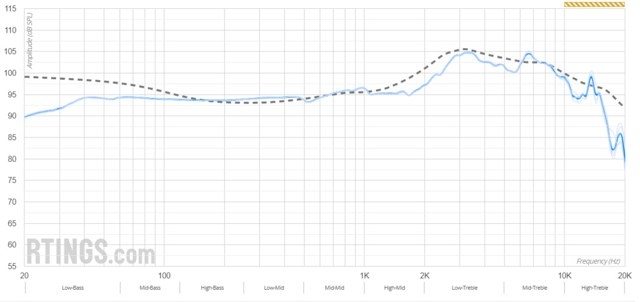
Distortion can describe any change in a signal's waveform between two points in a system. Harmonic distortion is more specific: it introduces unintended frequencies at integer multiples of a fundamental frequency. Not every form of distortion is undesirable; equalization and electric guitar pedals, for example, can alter sound for artistic purposes.
For playback equipment, however, added harmonics are a reproduction error. They can give music a colored, harsh, or muddy character. In practice, hearing this distortion is difficult unless headphone drivers are driven to volumes well beyond safe listening levels. Harmonic distortion should therefore carry little weight in a headphone purchase.
The testing described here measures harmonic distortion at 94 dB SPL and 104 dB SPL. The results include graphs of the total harmonic distortion (THD) ratio and second- and third-order harmonics, plus a weighted average THD calculated for each sound pressure level.
Where Low Distortion Matters
Low harmonic distortion is desirable for listeners seeking faithful, uncolored playback, particularly in audio mastering and critical listening. Classical music is one example where this preference may be especially relevant.
Nevertheless, people often cannot hear moderate distortion—and sometimes even high amounts. In the source team's investigation, trained listeners struggled to identify distortion substantially beyond the amounts normally found in most headphones. Apart from extreme examples involving very cheap components or poor quality control, distortion performance is unlikely to be a useful deciding factor. When it does become audible, it can compromise clarity, especially at louder levels, where harmonic distortion usually increases.
Interpreting the Measurements
Although raising playback volume generally raises THD, some headphones show the opposite behavior within particular frequency bands.
Listeners are particularly tolerant of distortion in the bass. Even highly regarded, sought-after headphones can produce apparently substantial THD without an audible loss of quality: a measurement rig can detect changes that listeners cannot. This Julian Krause video examines distortion audibility using polyphonic music and test tones at different frequencies. The source team's trained-listener investigation likewise found detection thresholds well above typical listening levels.
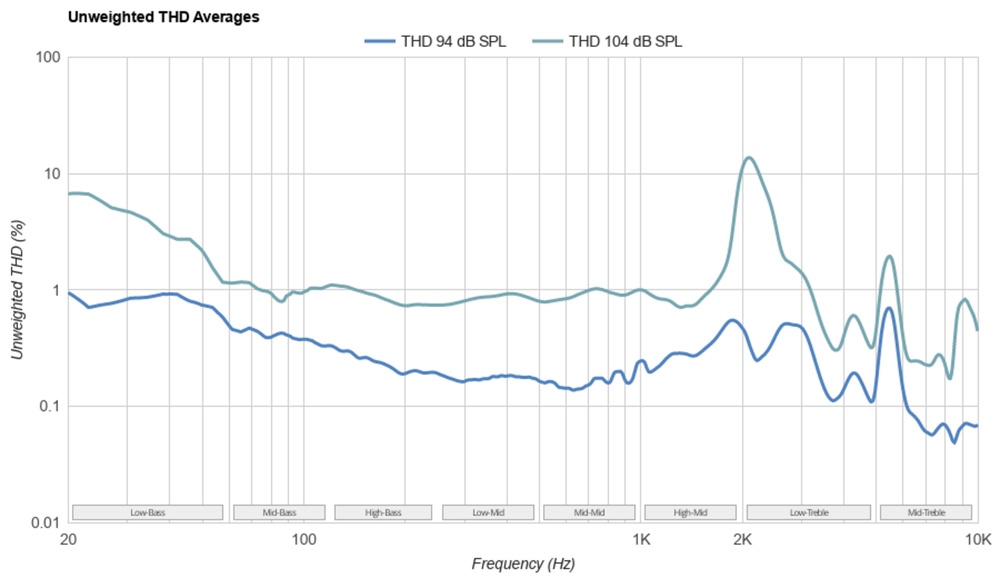
Masking helps explain why measurable distortion may go unnoticed. One sound can affect the perception of another; with spectral masking, a louder tone obscures a quieter tone nearby in frequency. Lower-order harmonics are consequently more likely to be hidden by the fundamental. Localized THD spikes also tend to stand out more than a consistently elevated response.
What THD Can—and Cannot—Tell You
THD is the established distortion measurement for headphones and other audio equipment, but it has important limits. With music rather than test tones, almost all commercially available headphones produce distortion that remains inaudible to trained listeners at ordinary playback levels.
The source team's measurements use a weighting filter that accounts for equal-loudness contours and the ear's greater sensitivity to higher-order harmonic distortion. This improves the context of the results without removing the test's limitations. The measurements still offer a broad view of a headphone's acoustic behavior, rather than a complete assessment of audible fidelity.
Research and Alternative Measures
Research reports only a moderate relationship between a device's THD response and perceived fidelity (Temme et al., 2014; Geddes et al., 2003). The relative strengths of individual harmonics, masking, and other psychoacoustic effects can leave even high measured THD with little audible consequence.
The test signal may also matter. A single-tone sweep, used to measure harmonic distortion, may load headphones less heavily than full-spectrum music with strong bass. Dense polyphonic material can generate more intermodulation products, which are harder to mask (Voishvillo, 2006). More noticeable distortion in full-spectrum music is therefore possible, but investigating it falls outside these tests.
Researchers have explored alternatives including inter-modulation distortion (IMD), multi-tone distortion, non-coherent distortion (Brunet et al., 2006), and PEAQ (Perceptual Evaluation of Audio Quality). Of these, non-coherent distortion has been demonstrated to be a stronger indicator of audio fidelity. Other approaches reinterpret THD: the GedLee metric, for example, includes masking and other psychoacoustic phenomena in its calculations.
References
- Brunet, Pascal and Temmes, Steve. A New Method for Measuring Distortion using a Multitone Stimulus and Non-Coherence. Listen, 2006; Audio Engineering Society 121st Convention Papers.
- Geddes, Earl R., and Lidia W. Lee. Auditory Perception of Nonlinear Distortion. 2003; GedLee LLC.
- Temme, Steve, et al. The Correlation between Distortion Audibility and Listener Preference in Headphones. 2014; Listen, Harman International.
- Voishvillo, Alexander. Assessment of Nonlinearity in Transducers and Sound Systems – from THD to Perceptual Models. 2006; Audio Engineering Society - 121st Convention Papers, 2.
- Yost, William A. It is too loud!. 2020; The Journal of the Acoustical Society of America, vol. 148,2: R3.
Article Updates
March 11, 2026: Revised as part of Test Bench 2.1 to incorporate recent findings from the source team's literature review and distortion investigation.