SoundGuys independently selects featured products and may earn commissions from purchases through its retail links.
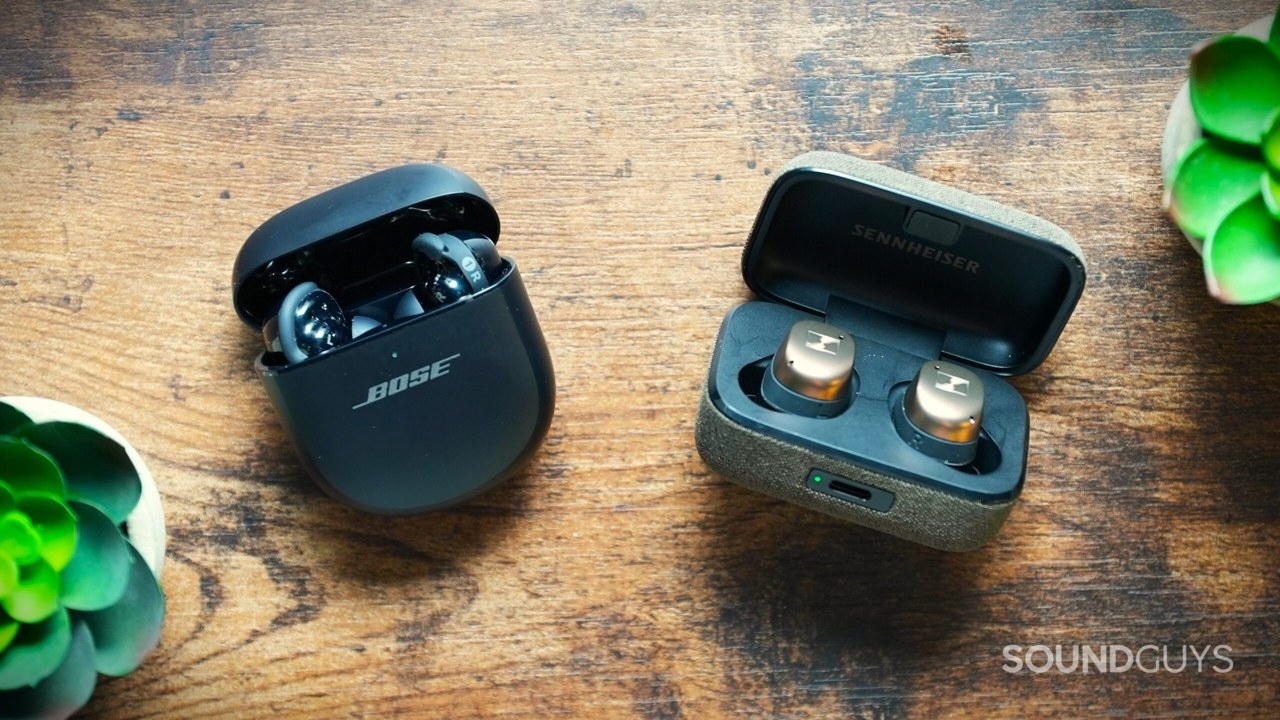
The Sennheiser MOMENTUM True Wireless 4 and Bose QuietComfort Ultra Earbuds were flagship true wireless options in 2024, combining advanced audio codecs with excellent active noise cancelation (ANC). Their main differences concern sound tuning, noise reduction, connectivity, and battery endurance.
This comparison was published on April 12, 2024, revised on April 21, 2025, and updated on December 11, 2025, to acknowledge the newer Bose model. The Bose QuietComfort Ultra Earbuds (2nd Gen) replace the originals but are a different product from the earbuds examined here.
At a glance
| Model | Listed MSRP | Review score | Strengths | Drawbacks |
|---|---|---|---|---|
| Sennheiser MOMENTUM True Wireless 4 | $349.95 | 8.5 | IP54, Auracast and LE Audio support, sound quality, ANC performance, aptX Lossless, wireless charging | Sub-par microphones and high price |
| Bose QuietComfort Ultra Earbuds | $299.00 | 7.7 | Fit, comfort, ANC, battery life, and app | Excessive bass and high price |
Sennheiser’s earbuds are strong all-rounders rather than outright leaders in any single area. Bose offers a dependable option around $300, particularly for buyers interested in Snapdragon Sound, although its bass-heavy presentation will not suit everyone.
Design, fit, and controls
Metallic details give the MOMENTUM True Wireless 4 a jewelry-like appearance. The housings are relatively large, but three sizes of concha fins help secure them comfortably. Their oval nozzles do not require deep insertion.
Bose also uses oval nozzles, which sit without pressing against the ear canal and may fit some ears better than cylindrical designs. Its chunky housings have a futuristic, Star Trek-like appearance. Both models use capacitive touch controls, avoiding button presses that could disturb the ear tip seal.
Sennheiser controls
| Input | Left earbud | Right earbud |
|---|---|---|
| Single tap | Transparency mode | Play / Pause |
| Double tap | Track backward | Track forward |
| Triple tap | ANC | Voice assistant |
| Long press | Volume down | Volume up |
Bose controls
| Gesture | Playback function | Call function |
|---|---|---|
| Swipe up | Volume Up | N/A |
| Swipe down | Volume Down | N/A |
| Tap | Play / Pause | Answer call / Answer second call |
| Double tap | Track Forward | End / Reject call |
| Triple tap | Track backward | N/A |
| Long tap | Mobile device control / User control preset | N/A |
The Bose app lets you assign the long-press action independently on either earbud.
Apps and wireless features
Sennheiser Smart Control provides an equalizer, personalized sound, firmware updates, and location-based programming for different listening situations. The Bose Music app is needed for immersive audio, gesture customization, and firmware updates, though its EQ offers limited help in reshaping the earbuds’ sound.
The MOMENTUM True Wireless 4 use Bluetooth 5.4 with SBC, AAC, aptX Adaptive, and aptX Lossless. A firmware update adds LE Audio using LC3, and the earbuds can receive available Auracast broadcasts.
The QuietComfort Ultra Earbuds use Bluetooth 5.3 and support SBC, AAC, and aptX Adaptive. Snapdragon Sound also brings aptX Lossless for high-resolution, low-latency playback with compatible devices. That compatibility is a notable Bose advantage, offering strong latency and data-transfer capabilities, although some compression remains necessary.
Battery life and noise cancelation
SoundGuys’ standardized battery testing recorded 7 hours and 45 minutes from the Sennheiser earbuds, compared with 6 hours and 11 minutes from Bose. Both charging cases supply additional charges, and both models support fast charging.
Bose held a slight overall advantage in SoundGuys’ noise-canceling tests. It reduced perceived loudness by up to 90% in some ranges and attenuated noise above 1kHz by up to 39dB.
Sennheiser remained highly effective, averaging 83% noise attenuation and physically blocking almost 50dB at higher frequencies. As with any earbuds, achieving full noise reduction requires a proper ear tip seal.
Sound quality
SoundGuys’ objective MDAQS assessment favored the MOMENTUM True Wireless 4 for out-of-box sound. Sennheiser scored 4.8 out of 5 overall, including 4.9 for Timbre Reproduction and 4.4 for Immersiveness. Bose scored 4.4 overall, with 2.2 for Distortion and 3.9 for Immersiveness.
These mean opinion scores (MOS) estimate the reactions of a virtual listening panel, not unanimous preferences: individual responses can differ substantially. Nevertheless, the assessment indicated objectionable distortion from Bose and considerably less from Sennheiser.
- Timbre (MOS-T): Measures fidelity across the frequency spectrum and temporal resolution, or timing information.
- Distortion (MOS-D): Evaluates added noise and nonlinearities; a higher score indicates cleaner reproduction.
- Immersiveness (MOS-I): Assesses perceived source width and how clearly virtual sounds occupy three-dimensional space.
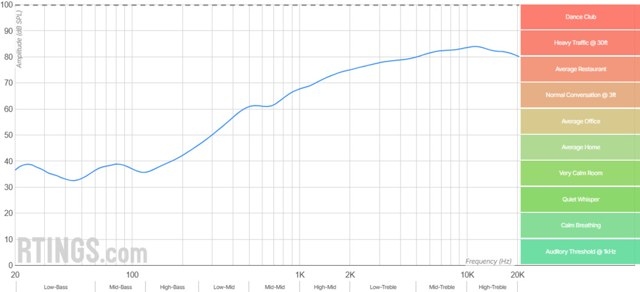
Relative to SoundGuys’ headphone preference curve, Bose emphasizes both bass and treble strongly, which can sound overwhelming or less natural. Sennheiser combines a modest bass lift with a manageable reduction in treble, producing a more versatile balance across musical styles. Both support EQ adjustments.
Microphone performance
Neither model excels at voice capture. Sennheiser’s microphone quality varies considerably and handles wind poorly. Bose performed slightly better for calls, but its small microphones still cannot match dedicated microphones for fidelity.
Pricing and availability
The Bose QuietComfort Ultra Earbuds ($299 at Amazon) arrived in fall 2023, followed by the Sennheiser MOMENTUM True Wireless 4 ($269.95 at Amazon) in spring 2024. Although the listed MSRPs and retail offers above differ, the comparison also describes both models as available for $299 through electronics retailers or directly from their manufacturers.
Which should you choose?
For Android users prioritizing future technological relevance, the comparison favors Bose as the safer choice. Its strong ANC, Snapdragon Sound support, and bass-forward tuning have broad appeal. The customizable fit and immersive audio are further attractions.
Listeners seeking a more balanced, high-fidelity presentation will likely prefer Sennheiser. Multipoint connectivity also makes it attractive for switching between devices. The decision ultimately weighs Sennheiser’s sound and styling against Bose’s noise cancelation and heavier bass; both offer features expected to remain useful for the next few years.
Compatibility and durability questions
- Are they waterproof? Neither is fully waterproof. Sennheiser’s IP54 rating covers dust and water resistance; Bose carries an IPX4 water-resistance rating.
- Can they handle exercise? Their water and sweat resistance makes running or workouts feasible, though tougher sports earbuds may be more suitable.
- Do they work with phones? Both connect to iPhones and Android phones over Bluetooth. iPhone playback is limited to AAC.
- Do both include ANC? Yes, both reduce ambient sound using active noise cancelation.
- Can they connect to PS4 or PS5? Neither console natively supports Bluetooth connectivity for these earbuds; a third-party adapter is required.
Before commenting, please review the Comment Policy.